

Key Takeaways
- The Core Binary: Modern engineering and technology disciplines in the United States require equivalent mastery over structured software logic (code) and comprehensive narrative synthesis (composition).
- The Resource Gap: Over 72% of computer science undergraduates leverage external frameworks to maintain parity with rigorous university-level code bases and advanced policy papers.
- Strategic Integration: Success in competitive institutional tracks depends heavily on systemic workload balance, data-driven task execution, and early integration of scholarly models.
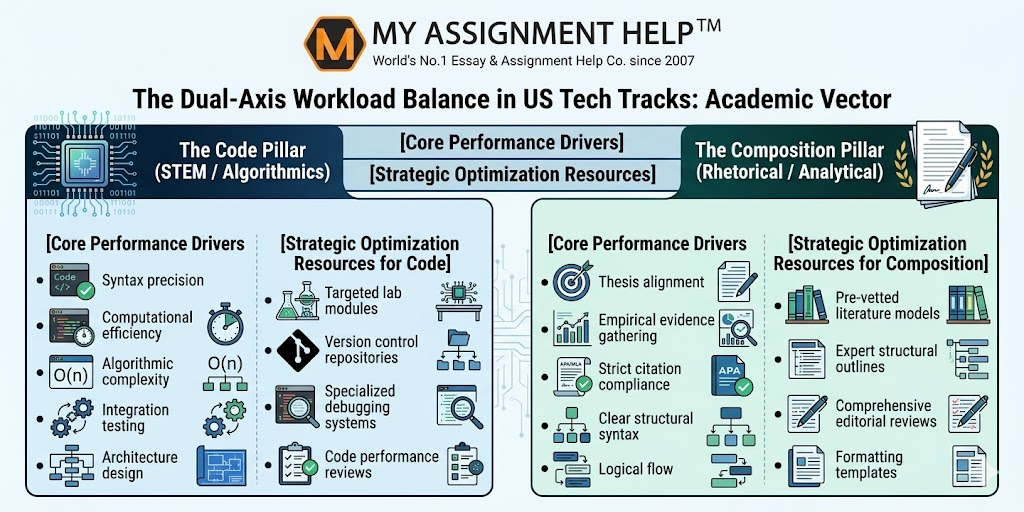
The contemporary landscape of United States higher education has undergone a tectonic shift. For decades, a strict binary separated academic disciplines: STEM majors occupied the quiet domains of specialized laboratories and computing clusters, while humanities scholars refined their craft through expansive rhetorical discourse. However, the modern digital economy has shattered this historical separation. Today, undergraduate and graduate students pursuing advanced tracks in computer science, software engineering, and data analytics face a demanding dual reality. Academic excellence is no longer measured solely by the compilation of bug-free algorithms, nor is it satisfied by superficial textual summaries. Instead, institutional excellence requires deep proficiency in both structural logic and written rhetoric.
In the highly competitive US higher education system, students are increasingly required to master both technical execution and long-form analytical communication. Navigating advanced STEM syllabi often requires external practical resources, leading many undergraduates to seek reliable help in programming assignments to keep pace with rapid development cycles and intricate debugging requirements. At the same time, the institutional expectations surrounding core humanities courses, general education blocks, and engineering research modules remain remarkably unyielding. To prevent cognitive overload and maintain strict academic performance indexing, students frequently look to buy term paper online frameworks from credible writing specialists to analyze high-scoring structural models, allowing them to balance engineering demands with strict academic writing benchmarks.
The Structural Architecture of Technical and Written Logic
At their core, software programming and professional academic writing are driven by identical cognitive processes. A well-constructed program relies heavily on precise logic, architectural clarity, modular efficiency, and strict syntax. If the underlying logic is flawed, or if an argument breaks down mid-execution, the system fails. Similarly, a comprehensive academic term paper or research treatise demands precise structural organization, transition efficiency, data-backed assertions, and strict adherence to documentation style guides (such as APA, IEEE, or MLA). The translation of abstract conceptual relationships into physical, readable prose mirrors the exact process of transforming a complex mental algorithm into clean, executable source code.
Data from the National Center for Education Statistics (NCES) indicates that enrollment in undergraduate computing and information sciences programs within the United States has grown by over 43% over the past decade. Yet, attrition rates within these disciplines remain among the highest across all undergraduate majors, often hovering around 28% to 35%. Empirical institutional studies reveal that this attrition is rarely caused by a student’s inability to write code alone. Instead, it is frequently exacerbated by a multi-dimensional workload that demands rapid context-switching between writing complex code segments and drafting lengthy technical documentations, lab reports, and required elective essays.
Addressing the Cognitive Load of Interdisciplinary Academic Frameworks
The distribution of student cognitive capacity across diverse academic performance metrics presents a profound structural challenge. Under academic guidelines enforced by major US regional accrediting bodies (such as the Higher Learning Commission or the Middle States Commission on Higher Education), degree programs must maintain strict foundational writing requirements to ensure long-term career readiness. Consequently, an engineering candidate cannot simply ignore the humanities. A senior software design capstone project at a premier American university often requires a technical specification document exceeding 50 pages—a document that requires impeccable rhetorical formatting, rigorous market analysis, and a clear articulation of structural methodologies.
When faced with this interdisciplinary pressure, contemporary tech students encounter significant time-allocation bottlenecks. For instance, debugging an asynchronous multi-threaded program can easily absorb 15 hours of intense, focused problem-solving. If that same student is simultaneously tasked with compiling a 4,000-word critical analysis on economic policy or tech ethics, the risk of burnout increases exponentially. This reality underscores the strategic necessity of utilizing external academic resources. Academic scaffolding frameworks—whether through dedicated tutoring networks or expert writing models—do not replace student effort. Rather, they serve as essential structural guides that lower cognitive stress, clarify confusing formatting requirements, and provide illustrative benchmarks for successful execution.
Synthesizing Authoritative Pathways for Modern Technological Authorship
For research-driven content to succeed in contemporary search architectures, it must align completely with modern criteria for information evaluation. In the academic space, true domain authority requires an organic blending of theoretical knowledge with functional, real-world utility. When digital platforms discuss student strategies, they must provide verified insights reflecting the actual, day-to-day challenges faced within the current university infrastructure.
Furthermore, as search engine ranking systems become increasingly sophisticated, the demand for deeply authoritative, data-backed writing has peaked. Algorithmic patterns are highly proficient at separating generic, surface-level text from high-value, human-curated strategic analysis. Consequently, academic resource providers must prioritize content depth, primary industry citations, and practical workflows over thin, repetitive copy. By focusing on detailed, multi-layered explanations of structural logic and compositional writing, digital entities build structural trust while answering the specific, complex queries of modern students.
Systemic Best Practices for Achieving Academic Equilibrium
To successfully navigate the high demands of modern technological curricula within the United States, students should adopt structured, systemic frameworks for managing their workloads:
- Implement Rigid Task Modularization: Treat written compositions and coding projects as interconnected micro-deliverables. Rather than trying to write an entire term paper or build a complex database architecture in a single session, break the work down into specific sub-routines, such as algorithmic outline mapping, comprehensive source gathering, and iterative syntax reviews.
- Utilize Empirical Benchmark Analysis: Before drafting an advanced technical report or term paper, review high-scoring architectural models to analyze proper structural alignment, stylistic choices, and citation pacing. Examining vetted, expert-level materials provides an immediate framework for success, ensuring that your final output adheres completely to the rigorous expectations of academic evaluation committees.
Frequently Asked Questions
Q1: Why are computer science and tech majors required to execute high-level academic writing in the US?
US higher education emphasizes a comprehensive, holistic learning model. Technology leaders must be capable of translating highly technical specifications into clear, actionable business strategies for non-technical stakeholders. Writing-intensive courses ensure that engineers can articulate complex ideas effectively throughout their professional careers.
Q2: How do external writing models help technical students improve their composition performance?
External scholarly models serve as clear structural blueprints. By studying pre-vetted academic term papers, engineering students can quickly master proper citation integration, logical transitions, and academic formatting without sacrificing the extensive hours required for their core coding lab assignments.
Q3: Can a student utilize external assistance tools without violating institutional integrity guidelines?
Yes, completely. Utilizing external resources as educational scaffolding—such as studying expert reference models, seeking guided debugging support, or reviewing structural frameworks—is a standard, ethical learning practice designed to supplement the educational experience and deepen conceptual understanding.
Q4: What are the primary structural similarities between software programming and academic writing?
Both fields require rigorous logical ordering, syntax precision, and clear organizational architecture. A flaw in an academic argument destroys the validity of a thesis, much like a logic error or a missing semicolon halts the execution of a software application.
About the Author
Dr. Elizabeth Vance is a Senior Content Strategist and Academic Consultant at MyAssignmentHelp, a leading international platform specializing in comprehensive student resource provision and educational scaffolding. With over twelve years of experience engineering high-authority curriculum models and advising on STEM communication strategies across top-tier US institutions, her research focuses on minimizing cognitive load patterns through targeted academic support frameworks.
Sources and Empirical References
- National Center for Education Statistics (NCES). (2023). Digest of Education Statistics: STEM Enrollment Trajectories in US Higher Education. US Department of Education.
- Computing Research Association (CRA). (2024). Taulbee Survey: Attrition, Enrollment, and Graduation Trends in Undergraduate Computer Science and Engineering Disciplines. CRA Publishing.
- Harvard Business Review. (2022). The Hybrid Skills Gap: Why Technical Roles Demand Advanced Communication Literacy. Harvard Business Press.