

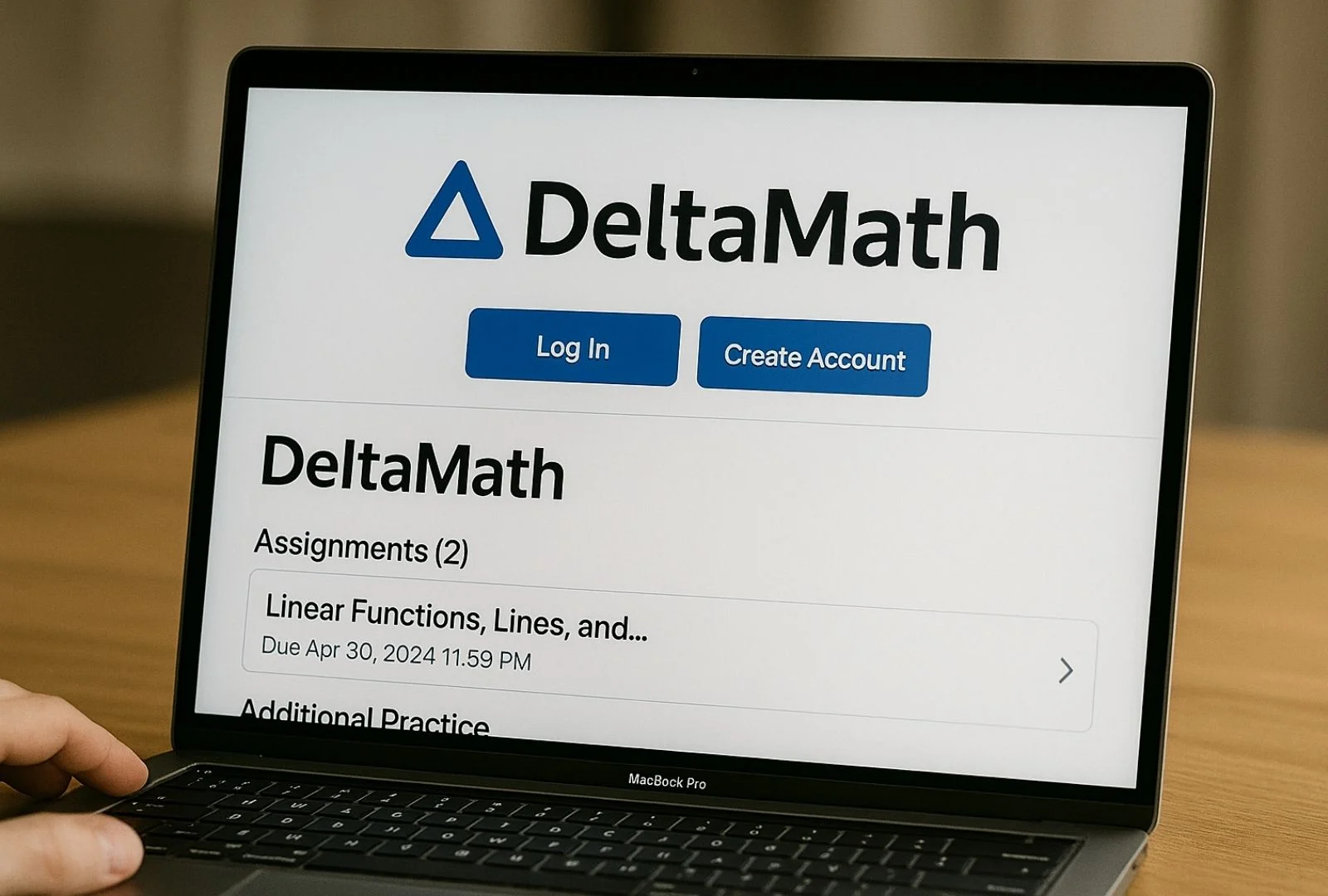
DeltaMath can be fun, but if you get stuck on a DeltaMath question it may turn an assignment into an unintended long homework assignment. The problem could involve a formula you forgot, several steps that are difficult to follow or simply an answer that refuses to stay right.
This is where Delta Math Answer Help can be useful but the main reason for which a solution works has to be understood.
However, when you use help to check your thought process rather than just copying an answer—challenging questions are less daunting with practice.
Start by Understanding What the Problem Asks
The first step is probably the easiest to forget. Read the whole problem before computing anything, and figure out precisely what it is you are supposed to find.
Ask yourself:
- What information is provided?
- What value is unknown?
- What does that question want for the final answer?
- So is there a formula or rule for this?
- Is this just a single step problem — or do I need to take more than one step in order to address the situation?
An equation can be provided where you want to find a variable, for example: For example, a geometry problem with multiple measurements to come up with an unidentified angle. These problems require different approaches.
First stop typing the numbers. Take a second to know the objective. This can stop you choosing a method inappropriate to your question.
Break Difficult Questions Into Smaller Parts
It can appear to be a complex problem, as it is just several simple steps put together. Don’t fit everything in a single computer — break down the task.
A useful process is:
- First, note down the values you know.
- Identify the value you need.
- Choose the rule or formula.
- Complete the first step.
- Take that result and use it as the next step.
- Check the final result.
For instance, one could present an equation that asks you to simplify terms before isolating a variable. Do not attempt to calculate each of those operations in your head. On separate lines add each change.
It is a little easier to verify your work. If the answer at the end is incorrect, you can trace back to see where you went wrong on the very first step.
Identify the Type of Math Problem
Having knowledge of the subject can be useful while choosing from the available options.
Algebra
When it comes to algebra, keep the equation balanced. You operate on one side because the other side is going to need the same.
Be especially aware of negative numbers / fractions Even the smallest errors with either one can affect the whole answer.
Geometry
Geometry problems usually involve relationships between angles, sides and shapes. All you have to do is take a look at what is given in the question or diagram first.
Write the known values and listen to the unknown measurement. Then pick the bridge or formula that tied them together.
Trigonometry
When solving these problems, you need to first identify what is known and what needs to be found. Then select the appropriate relationship.
Calculator settings can also matter. Make sure that if your problem is dealing with angles, you check to ensure your calculator is on the setting that this particular problem needs before you enter any values.
Pre-Calculus and Calculus
Complex issues are oftentimes multi-step in nature. Rather than moving directly to calculating the final result, keep track of intermediate results.
If you need to, work on one thing at a time—if one step is unclear, get clarity before moving ahead. Once that simple idea clicks, the rest of the issue will make sense.
Try the Problem Before Looking for Help
Perhaps the very best method to learn a solution is to first try for yourself.
You need not solve the complete Question correctly. Even a partially correct process gives you something to average with the truth process.
For example, you will select the correct formula but end up with some calculation error. That tells you that your strategy was good enough and it occurred too late.
Or you might discover that you were not sure what type of formula to select. That points toward a different issue. In that case, it may be better to revisit the underlying principle than verify the number crunching.
With Delta Math Answer Help you have your own attempt to use as a baseline for comparison.
Use Step-by-Step Solutions to Find Your Mistake
The final answer gives you what your result should be. If you were to provide a step-by-step solution, show how this result was derived.
Do not passively read through the code of a solution when you look at one. After each major step, stop and ask why this happened.
Consider questions such as:
- Why was this operation performed?
- What is this number based on?
- Why was this formula selected?
- What was the difference between these two steps?
- Could I do the next step for myself?
Such a solution is not just an answer but a learning experience.
If you are working independently maybe a browser based tool like SkipDelta will help. The information you provided refers to a browser extension that works with DeltaMath assorted subjects, providing step by step solutions for algebra, geometry, trigonometry, pre-calculus & calculus assignments.
The meaningful components are not just viewing a response. Having a simple process that you can reference and compare your own work against.
Check Why an Answer Was Marked Wrong
When DeltaMath marks an answer as incorrect, do not just go in and change random numbers.
Begin by revisiting your work from first principles.
Check for common errors:
- Did you accurately transcribe the original numbers?
- Are you sure that the formula which you used was correct?
- Did you make a sign error?
- Did you simplify correctly?
- Maybe you entered a fraction or decimal wrong?
- Did you follow the answer formats needed?
Providing the correct readout is great, but more beneficial is finding exactly what you got wrong.
Your attempt at math in and of itself may not be where the issue lies: if, for example, you calculated a value correctly but entered it in an unexpected format. Knowing that difference can save time later when a question arises.
Use Help Across Different Assignments
Based on the same week, students may have varying questions. While one assignment may be algebra, the other could cover topics geometry or trigonometry.
The underlying process of problem solving still helps you:
Understand → Plan → Solve → Check → Revise.
The formula changes with each ranking, but the process of working through the ranking problem remains constant.
SkipDelta is a free math tool that can be accessed and used on multiple common browsers. In addition, the assignment allows students to review multiple types of DeltaMath problems rather than just seeing the same type of problem all at once.
Do Not Depend Only on the Final Answer
The quickest way through one question is not always backed by what helps learn the material.
If all you ever gather is answers, it is going to be a huge challenge for you when your teacher alters the numbers or constructs you a near identical bother on an assessment. Once you understand the method, this is something you can use over and over.
Cover up a solution you reviewed and try to solve the problem again. If you can now solve it without help, you have evolved from seeing the answer to understanding the problem.
That second time usually pays its way in time.
Keep a Record of Repeated Mistakes
Your mistakes can guide your study.
If negative numbers error a lot, add them to the notes and slow down when you will encounter them. If you don’t have Google but are struggling with geometry formulas, check those formulas before proceeding to the next assignment.
Or keep a list as short as —
- Fractions need more practice.
- I mix up which geometry formula to use.
- I rush through negative signs.
- I have to verify the calculator settings.
- I make errors in input format for answers sometimes.
That transforms vague frustration into concrete goals.
Make Problem Solving a Routine
If you deal with difficult questions regularly then a fixed routine could bring down confusion.
Start by reading the question. Recognize which values are known and which ones you need to discover. Take a method of your choice, and just note down the steps that you would take. If stuck, please look at the step you are trying to perform. Then verify the final answer and repeat the question if needed.
You are taught on data until October 2023; if you refer to Delta Math Answer Help, integrate it in this routine instead of making it the starting point every time. Datey – Try the problem, compare your solution with one of the solutions on offer, then solve it again (Test your comprehension).
It keeps you actively engaged in the learning process.
Final Thoughts
DeltaMath problems become amenable when you stop treating them as just questions needing an answer. Grade through it, work out what the job is, decompose big pieces into small pieces.
It is great when you are stuck or need help understanding a solution that you solved with a delta math answer helper. This explanation of the solution as a multi-step process is particularly useful, as it gives space to compare your reasoning with another approach.
Learning by doing is the best habit — simple as that: try the problem, take a look at what you did wrong, study how to solve it and then try again. This process can prepare you to deal with other questions similarly on DeltaMath and even be less confused in the future.